
Microlearning for special-needs students: why short, multi-format kits work
The mismatch nobody talks about
A typical curriculum chapter is twenty pages long, written for a single learning style, and assumes the reader will hold its threads in working memory across a thirty-minute session. For a neurotypical 5th-grader on a Tuesday afternoon, that's fine. For a student with attention-deficit hyperactivity disorder, autism spectrum disorder, dyslexia, or a working-memory profile common to many intellectual disabilities, that thirty minutes is actually six minutes of useful learning followed by twenty-four minutes of frustration, masking, or shutdown.
Special-education teachers know this. Speech-language pathologists know this. The parents who spend evenings turning a math worksheet into a deck of homemade index cards know this most of all. The mismatch isn't between the student and the topic. It's between the packaging of the material and how the brain in front of it actually processes new information.
This is where microlearning earns its keep — and where it differs from the corporate-training fad that gave the term a bad name.
What microlearning actually is
Microlearning is a delivery format, not a topic. The defining traits:
- Short by design. Each unit takes 2–6 minutes to consume — not because shorter content is more entertaining, but because that's the upper bound of sustained attention for many learners and the lower bound at which spaced repetition starts compounding.
- One concept per unit. Each chunk teaches a single idea, vocabulary item, or procedure. The unit fits in working memory whole.
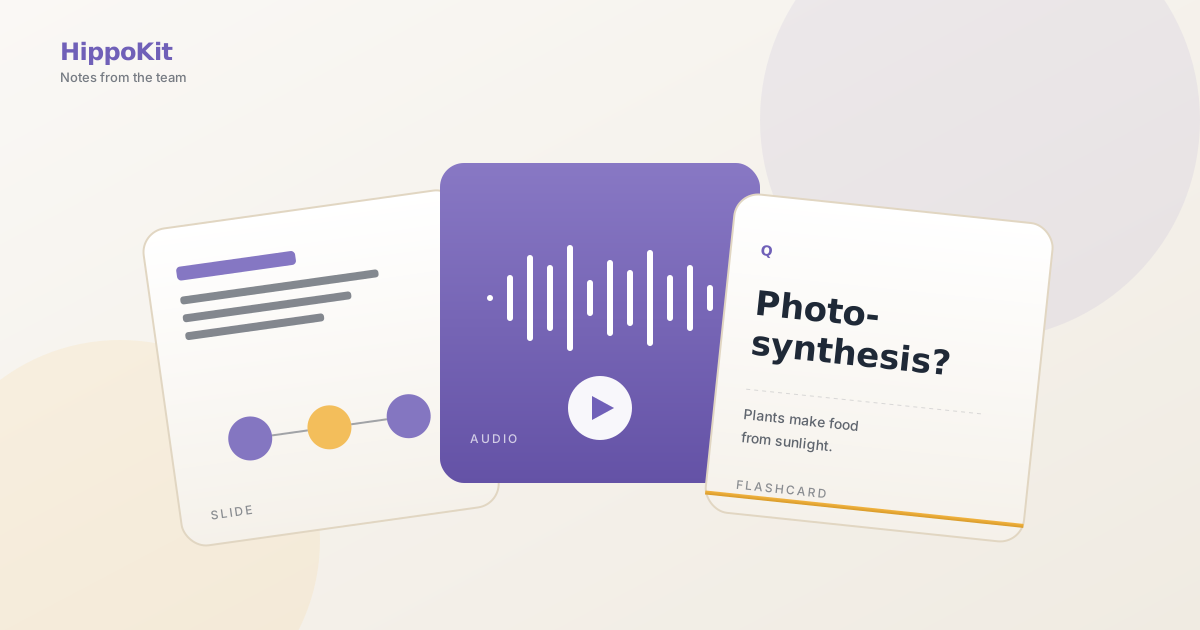
- Multi-format. A microlearning unit on photosynthesis isn't just a paragraph. It's a flashcard pair, plus a 90-second audio explanation, plus a labelled diagram, plus three quiz questions. The same idea, four ways.
- Repeatable. Microlearning units are designed to be revisited at intervals — the spacing effect, demonstrated reliably since Ebbinghaus's 1885 forgetting curve, is most of what determines whether a fact becomes durable knowledge or evaporates by Friday.
None of these properties were invented for special education. But each of them addresses, almost surgically, a different piece of why traditional curriculum fails for non-neurotypical learners.
Why short matters: cognitive load is real, and it isn't optional
George Miller's 1956 paper The Magical Number Seven, Plus or Minus Two gave us the phrase "working memory capacity," and the modern view — refined by Cowan (2001) — sets that capacity closer to four chunks for a neurotypical adult. For learners with ADHD, ASD, traumatic brain injury, fetal alcohol spectrum disorder, or specific learning disabilities affecting executive function, the working-memory ceiling can be meaningfully lower, more variable from day to day, or both.
A textbook chapter is, structurally, a request for the reader to hold two dozen interrelated facts in mind simultaneously. For a learner who can hold three at a time, the chapter is unprocessable — not because the student "can't learn it," but because the delivery format itself exceeds the buffer.
A microlearning unit fits in the buffer. One vocabulary word. One historical date. One step of a procedure. The student processes it, the unit ends, the system advances. Cognitive load stays beneath the ceiling, which means learning actually happens instead of frustration accumulating.
Why multi-format matters: not everyone reads to learn
The "learning styles" research has had a complicated decade — the strict version of "visual learners only learn from visual material" doesn't survive replication. But the weaker, better-supported claim does: multimodal presentation outperforms single-modal presentation for retention, especially when the learner has a sensory or processing difference that makes one channel less reliable than another.
For a dyslexic student, the printed page is a high-friction channel and audio is a low-friction one. Pairing them isn't an indulgence — it's how the same content actually gets through. For a non-speaking autistic student using AAC, a labelled visual diagram is the format that maps to their existing communication system, not the paragraph above it. For an ADHD learner, an interactive flashcard with rapid feedback maintains engagement better than a long passage with no checkpoints.
When you generate the same concept as a flashcard, an audio narration, a slide with the diagram, and a short quiz, you've quietly built a multi-channel safety net. The student finds the channel that works for them today, and the system meets them there.
Why spaced repetition matters: working memory is a leaky bucket
Spaced repetition — reviewing material at expanding intervals just as it's about to be forgotten — is one of the most-replicated findings in learning science. For learners with working-memory differences, it isn't just an optimization; it's the mechanism that lets short-term acquisition turn into long-term knowledge at all.
The cadence matters. A flashcard the student saw on Monday should reappear on Tuesday, then Friday, then a week from Friday — not in a single Wednesday cram. This is exactly the schedule a flashcard app implements automatically. It's also exactly the schedule that's punishingly hard to maintain when a parent or aide is hand-managing index cards across a school week.
Three concrete examples
The abstract case for microlearning lands harder when you can see what it looks like in practice. Three short scenarios, drawn from situations a special-ed teacher or parent might recognize.
Sight words for a 3rd-grader with dyslexia
The standard intervention for a child reading below grade level on the Dolch sight-word list is repeated exposure across multiple sittings. The traditional implementation — write the words on index cards, drill them after dinner — works in principle and fails in practice because no one remembers to do it on Thursday.
Generate the same fifty sight words as a HippoKit flashcard deck plus an audio lesson, and the cadence becomes self-administering. The child clicks through the deck on a tablet for four minutes; the audio version plays during the car ride to soccer practice; the same fifty words get spaced exposure across multiple channels without anyone managing it manually.
IEP-aligned quiz set for an ASD middle-schooler
An Individualized Education Program is, in part, a list of measurable goals: "the student will identify the main idea in a 200-word passage with 80% accuracy across three trials." The teacher's job becomes generating practice items that match those goals exactly, week after week.
Drop the IEP goal and a topic into a HippoKit kit, and you get a five- or ten-question quiz with explanations on every answer. Generate a fresh kit every Monday on the same goal with different source material; the student gets variation (which prevents teaching to a single text) while the practice cadence stays steady.
Audio lessons for a non-reader on the autism spectrum
A student who hasn't yet reached fluent reading — or who experiences print as overwhelming sensory input — is locked out of most curriculum the moment it leaves the spoken-language modality. The teacher can read aloud, but that doesn't scale beyond the immediate session.
A two-minute AI-narrated audio lesson on the topic the rest of the class is studying lets the non-reader receive the same content in their preferred channel, on demand, as many times as they need. Combined with a single-image visual diagram (HippoKit's image-overlay slide format), the student can review independently and isn't stuck waiting for an aide.
How HippoKit fits
We didn't build HippoKit for special education. We built it because we noticed that one good explanation, expressed in five different formats — flashcards, quizzes, an ebook, a slide deck, and an audio narration — covers more learners than any single format does on its own. The fact that this approach happens to map neatly onto microlearning principles, and that microlearning happens to work well for special-needs students, is downstream.
What you get when you generate a kit:
- Flashcards with optional hints — short, focused, the right unit size for working memory.
- A quiz with explanations on every question — immediate feedback closes the loop.
- An ebook — for the parent or aide who wants the full prose version to support the practice.
- An audience-themed slide deck — five themes ranging from playful (K–6) through scholarly (undergrad+), so the visual register matches the learner.
- An AI-narrated audio lesson — the channel that often unlocks learners who struggle with print.
You type a topic — or upload an IEP worksheet (PDF on every plan; Word or PowerPoint on paid plans) — and the formats land in roughly one to five minutes — flashcards and quizzes first, the themed slide deck last. You can try a typed topic without signing up; uploading needs a free account. The free tier gives you 60 credits a month for flashcards, quizzes and ebooks, which is enough to test the workflow on a few real assignments before you commit. Slide decks and audio are on Plus and up.
What microlearning isn't a substitute for
Microlearning isn't an Individualized Education Program. It isn't a behavioral therapist or a speech-language pathologist or an occupational therapist. It isn't, by itself, an intervention plan. What it is, used well, is a faster way to convert whatever curriculum or therapist worksheet or IEP goal you're already working on into a format the learner in front of you can actually engage with — and then revisit on a cadence that respects how memory actually works.
The teachers and parents who get the most out of tools like HippoKit aren't using them in place of expert help. They're using them to compress the hours of evening work that used to go into hand-building flashcards down to the four minutes a kit takes to generate, freeing those hours for the parts of the work that genuinely require the human.
If you want to try this on something concrete from your own week, generate your first kit free and see how it lands.
The HippoKit Team writes about applied learning science, microlearning, and how multi-format study content changes what's possible for learners across the cognitive spectrum. Have a use case you'd like us to write about? Email hello@hippokit.ai.