
AI Literacy for Lawyers: What Actually Changes in Your Practice
Short answer
AI isn't replacing lawyers in 2026 — it's replacing the parts of the job that were always closest to a template, while raising the bar on the parts that were always closest to judgment. Adoption has crossed the majority mark at most firms, bar regulators have issued binding ethics guidance, and courts have started sanctioning lawyers six figures at a time for unverified AI output. "AI literacy" now means understanding the tools well enough to use the upside and avoid the sanctions — not becoming a computer scientist.
Will AI actually replace lawyers?
Probably not the job. Quite a lot of the tasks inside it, yes. Goldman Sachs's widely cited 2023 analysis estimated that 44% of current legal-industry work tasks are exposed to automation by generative AI — the second-highest of any occupation category it modeled, behind only office and administrative support at 46%, and well ahead of the roughly 25% cross-industry average (Goldman Sachs, via Law.com, 29 March 2023). That's a statement about tasks — first-pass document review, contract redlining, discovery summarization, initial research memos — not about the profession disappearing. Task automation and job elimination are different claims, and conflating them is where most of the anxiety comes from.
The anxiety itself is measurable and rising. Thomson Reuters Institute's 2026 AI in Professional Services Report, based on more than 1,500 professionals (including a large legal-sector cohort) across 27 countries, found that 50% of lawyers now view AI as a "major threat" to the unauthorized practice of law, up from 36% a year earlier — even as adoption keeps climbing (Thomson Reuters Institute, 2026). Adoption and anxiety are rising together, which is exactly the setup where "I'll figure it out eventually" stops being a viable plan.
How fast is adoption actually moving?
Faster than most other professions. Clio's Legal Trends Report (ninth edition, October 2024) found legal-professional AI usage had jumped to 79%, up from 19% in 2023 — a four-fold increase in a single year, with 70% of corporate clients preferring or neutral toward firms that use it (Clio / PR Newswire, 7 October 2024). Clio's follow-up Legal Trends for Mid-Sized Law Firms report (fourth annual edition, March 2026) put adoption at mid-sized firms at 86%, with 65% saying AI lets them take on higher volumes of work and 60% now operating under a formal, written AI-use policy (Clio, 9 March 2026).
Put plainly: the "should I even bother learning this" phase closed a while ago. The live question is how to build competence without becoming one of the cautionary tales below.
What's already gone wrong — and why it matters to you
The clearest evidence that AI literacy is now a professional-responsibility issue, not an optional skill, is the growing list of lawyers sanctioned for filing AI-fabricated material. The independent AI Hallucination Cases Database, maintained by legal-AI researcher Damien Charlotin, tracks court and tribunal decisions worldwide that found or implied reliance on hallucinated citations; as of late June 2026 it lists more than 1,600 identified cases and continues to grow by several new entries a week (checked 30 June 2026).
A few of the sanctions on record show how far this has escalated:
| Case | Court | What happened | Penalty |
|---|---|---|---|
| Mata v. Avianca (2023) | S.D.N.Y. | Attorney submitted six fabricated ChatGPT-generated case citations | $5,000 fine — the case that put AI hallucination on the profession's radar |
| Whiting v. City of Athens, Tennessee (March 2026) | 6th Cir. | Two attorneys' briefs contained 24+ fake or misrepresented citations across three consolidated appeals | $30,000 in direct fines ($15,000 each) — one of the most significant appellate sanctions rulings yet involving fabricated citations (LawSites, March 2026) |
| District of Oregon case (reported May 2026) | D. Or. | Briefs cited 15 nonexistent cases and 8 fabricated quotations | Roughly $110,000 combined in fees and fines — the largest AI-hallucination penalty an Oregon federal court has ever handed down (ABA Journal) |
None of these lawyers were sanctioned for using AI. They were sanctioned for not verifying what it produced — a distinction that matters enormously for how you should actually think about "AI literacy."
What your bar already requires
This isn't a gray area you get to define for yourself. On 29 July 2024, the ABA Standing Committee on Ethics and Professional Responsibility issued Formal Opinion 512, "Generative Artificial Intelligence Tools" — the first comprehensive national guidance mapping GenAI use onto the existing Model Rules (ABA, via Business Law Today). The obligations it lays out aren't new duties invented for AI — they're existing duties the profession now has to apply to a new tool:
- Competence (Model Rule 1.1). You have to understand a GenAI tool's capabilities and limitations well enough to use it responsibly, and keep that understanding current as the tools change.
- Confidentiality (Model Rule 1.6). You're responsible for knowing how a tool handles the data you put into it. Boilerplate consent buried in an engagement letter isn't enough — Formal Opinion 512 recommends specific, informed client consent before feeding client confidences into a GenAI tool.
- Meritorious claims and candor (Model Rule 3.1). You have to independently verify AI output before it goes anywhere near a filing. This is the rule the sanctions above all trace back to.
- Communication, supervision, and fees. Clients generally need to know when and how AI is used on their matter; you're responsible for supervising anyone at your firm who uses it; and you can't bill a client for the time it takes you to learn a tool generally (only for learning a specific tool at a specific client's request).
This sits on top of a broader, longer-standing baseline: 40 U.S. states, D.C., and Puerto Rico have formally adopted the "duty of technology competence" — the 2012 amendment to Comment 8 of Model Rule 1.1 stating that competence includes keeping abreast of the benefits and risks of relevant technology (LawSites Tech Competence tracker, checked 30 June 2026). AI literacy isn't a nice-to-have layered on top of that duty. It's what the duty now means in practice.
How the profession is already responding
Law schools and state courts are moving to close the gap before new lawyers even sit for the bar. Mississippi College School of Law became the first law school in the Southeast to require AI education, building it into its first-year curriculum specifically to "avoid a lot of the headlines that you've seen already where lawyers take shortcuts…" by using the technology carelessly, in the dean's words (Mississippi Today, 20 April 2026). UNLV's William S. Boyd School of Law will require all incoming 1Ls to take "Introduction to the Responsible Use of AI" starting Fall 2026, and the University of Chicago Law School has rolled out required AI-literacy modules for its first-year students. On the practicing-bar side, New Jersey's Supreme Court has approved a new one-credit CLE requirement in technology-related subjects — explicitly naming generative AI as a covered topic — for every New Jersey-licensed attorney.
If the people training tomorrow's lawyers are treating this as foundational rather than elective, that's a reasonable signal for practicing lawyers to do the same.
A practical AI-literacy checklist
None of this requires becoming technical. It requires being deliberate:
- Read your bar's actual guidance, not a summary of it. If your jurisdiction has issued a GenAI ethics opinion, that document — not a LinkedIn post about it — is the standard you'll be held to.
- Never file, send, or rely on an AI-generated citation, quote, or factual claim you haven't independently verified against the primary source. This single habit would have prevented every case in the table above.
- Know what your firm's AI policy actually says — and if there isn't one, that's itself a competence gap worth raising, since a documented policy is what regulators and clients are increasingly expecting to see.
- Get specific, informed client consent before putting client confidences into a GenAI tool — not boilerplate engagement-letter language.
- Treat "AI literacy" as ongoing, not a one-time training. The tools, the case law, and your bar's guidance are all still moving; Formal Opinion 512 itself frames competence as something to "periodically" refresh.
Turning that checklist into something you can actually study
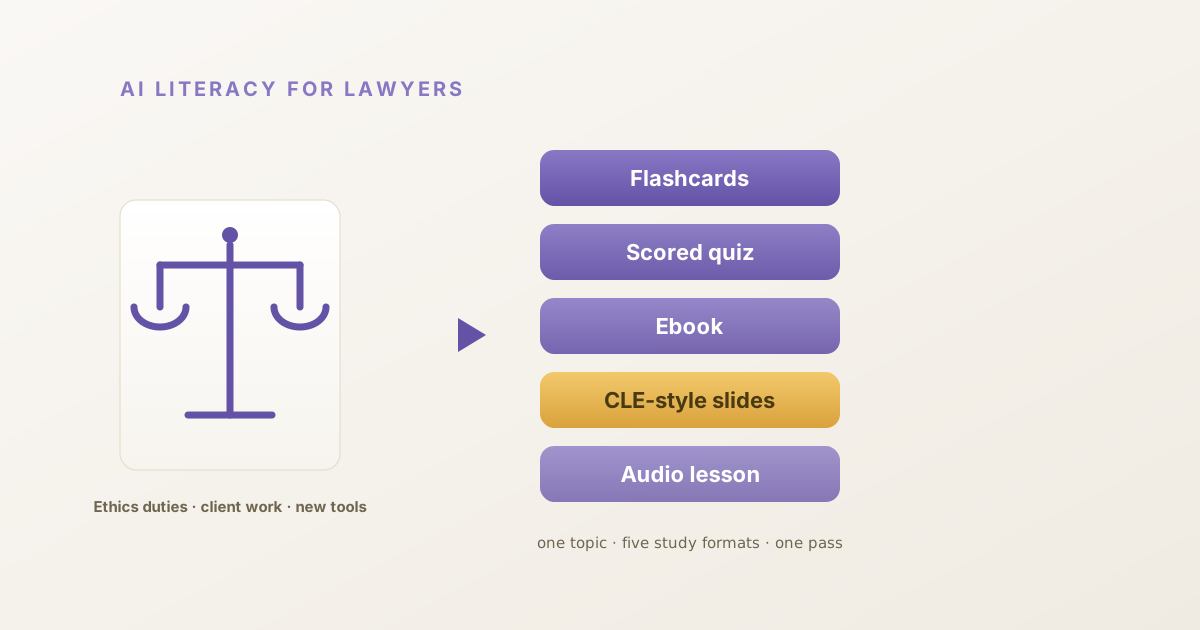
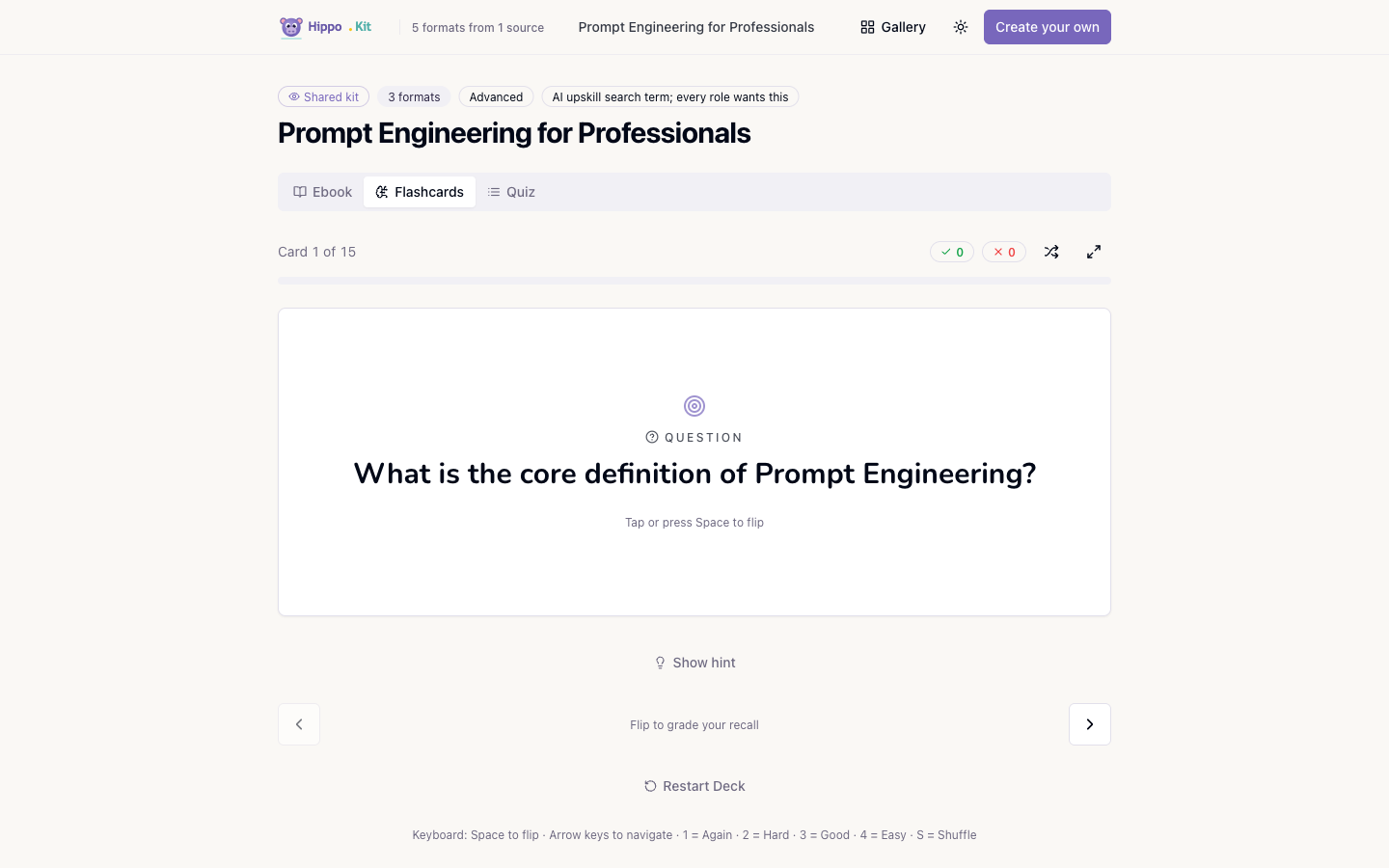
Reading a 30-page ethics opinion once and hoping it sticks isn't a great retention strategy — for this or anything else. This is the same "AI literacy" pillar behind kits like Prompt Engineering for Professionals in HippoKit's sample gallery — general-audience AI-literacy material built the same way a legal-specific version would be: one topic in, five study formats out.
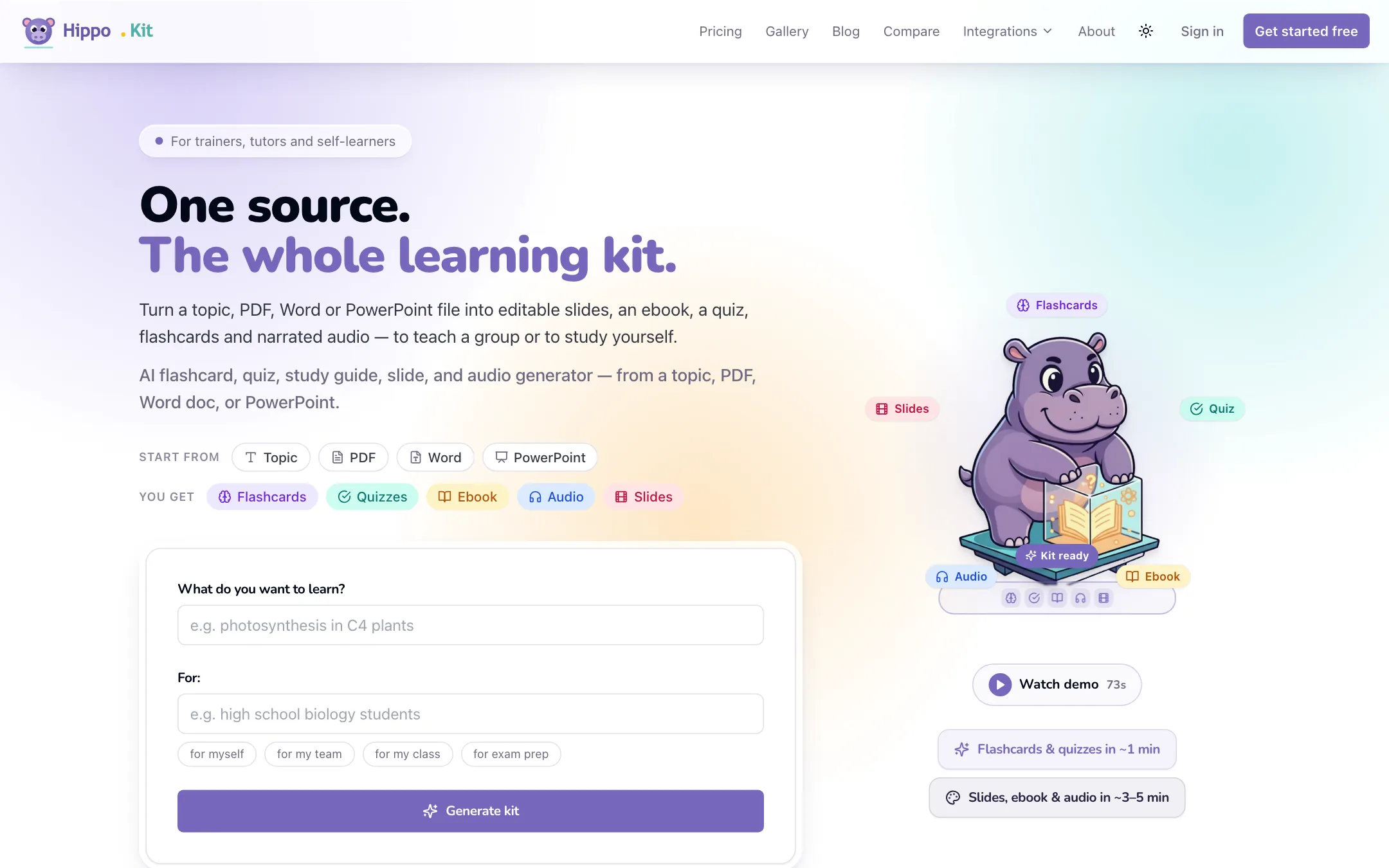
Drop in the text of your bar's ethics opinion, your firm's AI policy, or a CLE outline on generative AI, and HippoKit turns it into flashcards on the key duties, a scored quiz on the sanctions cases worth remembering, a short ebook summary and, on Plus and up, an Executive-themed slide deck you could actually use to open a lunch-and-learn and an audio recap for the commute — flashcards and quizzes land in about a minute, the slide deck and audio in about five. The free tier includes 60 credits a month, enough to build and test the flashcards, quiz and ebook before you'd need to pay for anything.
HippoKit doesn't give legal advice, doesn't do legal research, and isn't a substitute for your bar's own guidance — it's a faster way to turn material you already have and trust into something your brain actually retains, the same way a study kit works for any other subject.
Generate your first kit free — no credit card required.
— The HippoKit Team
FAQ
Will AI replace lawyers? Not the profession as a whole. Goldman Sachs estimates 44% of current legal tasks are exposed to automation — the second-highest of any occupation category it modeled, behind only office and administrative support — but that's a statement about which tasks change, not about the job disappearing. The work shifting fastest is the most template-like (first-pass review, initial research drafts); judgment, strategy, and client relationships are not what's being automated.
What is ABA Formal Opinion 512? It's the American Bar Association's first comprehensive ethics guidance on generative AI, issued 29 July 2024. It maps existing duties — competence, confidentiality, candor toward the tribunal, supervision, communication, and fees — onto the specific risks of using GenAI tools in practice.
Can I get sanctioned for using ChatGPT in a legal brief? You can get sanctioned for filing unverified AI output — not for using AI itself. Courts have imposed penalties ranging from $5,000 (the original 2023 Mata v. Avianca case) to roughly $110,000 for briefs containing fabricated citations and quotations that weren't checked before filing.
Is there a continuing-education requirement for AI specifically? It's emerging. New Jersey's Supreme Court has approved a one-credit CLE requirement in technology-related subjects that explicitly covers generative AI. More broadly, 40 states plus D.C. and Puerto Rico already require lawyers to maintain a general "duty of technology competence."
How do I get AI-literate without a lot of extra time? Start with your own bar's guidance and your firm's policy — those are the documents you'll actually be held to. Turning them into flashcards and a short quiz (rather than re-reading a PDF) is a faster way to make the material stick.